
Understanding U.S. Intervention in Venezuela
You cannot make sense of Nicolás Maduro’s removal without grasping the enormous financial interests involved with regime change in Caracas.

This is not to dismiss the ideological or geopolitical dimensions of U.S. intervention—reviving the Monroe Doctrine, reasserting imperial spheres of influence.
But oil is the core motive behind this power play: control over the world’s largest petroleum reserves, long exploited with extraordinary returns by U.S. multinationals and their shareholders.
Maduro was a brutal and corrupt autocrat. But Trump has never had any trouble working with brutal and corrupt autocrats; such traits rarely trouble him.
The real goal of the Trump operation lies elsewhere: reclaiming Venezuela’s oil rents for the benefit of America’s economic elite—an arrangement that peaked in the 1950s, during the mythic “golden age” endlessly invoked by the MAGA movement
To understand what the White House is aiming for, one must revisit this largely forgotten history: a period of cross-border extractive capitalism pushed to its extreme, which Trump now seeks to resurrect—and possibly surpass.
***
Venezuela’s oil industry was born in the 1910s with a fatal flaw: its resources were effectively handed over to foreign corporations.
The dictator Juan Vicente Gómez granted lavish concessions to U.S. and British oil majors, which rapidly scaled up production.
By 1929, Venezuela accounted for more than 10 percent of global oil output and had become the world’s largest exporter.
At first, British and American companies split the spoils. After World War II, the Americans largely took over. Venezuela became the single largest destination for U.S. foreign investment and one of its main sources of foreign income.
The scale of the wealth extracted from Venezuela in the mid-twentieth century is truly staggering.
Let’s take a look. In 1957, at the peak of this extractive regime, profits earned by U.S. oil companies in Venezuela were roughly equal to the profits earned by all U.S. multinationals—across all industries—in the rest of Latin America and in continental European countries combined.
About 12 percent of Venezuela’s net domestic product—the value of everything produced in the country each year—flowed directly to the pockets of U.S. shareholders. That was roughly the same amount of income received by the poorest half of the Venezuelan population combined.
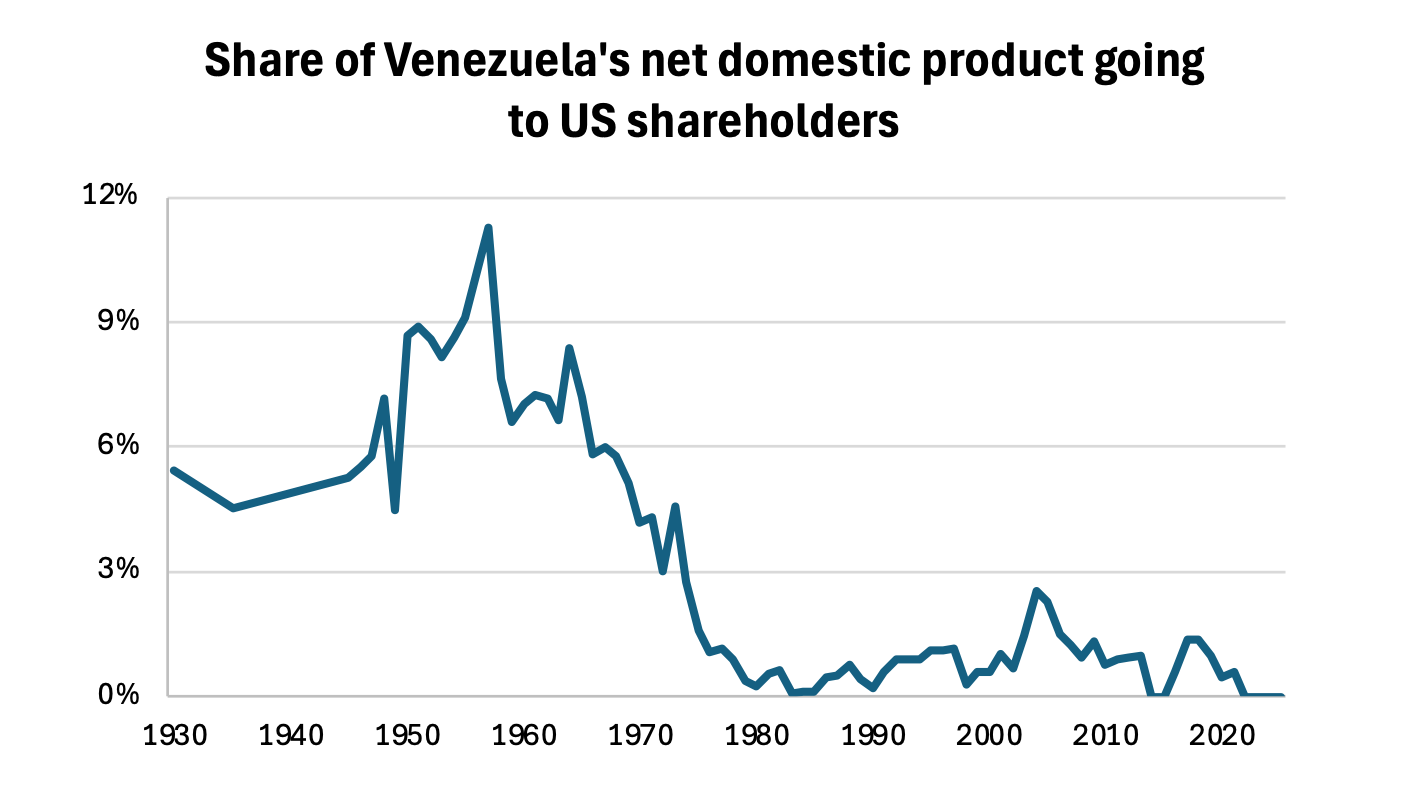
Venezuela’s economy was growing, but the gains overwhelmingly accrued to American investors and to well-paid U.S. expatriates.
By the early 1960s, Venezuela hosted the largest American expatriate community in the world, living in towns complete with modern hospitals and pristine baseball fields.
This is the “golden age” the Trump administration wants to bring back: a sharing of oil rents that is difficult to imagine being more unequal.
***
It is also an inherently unstable development model, one bound to provoke backlash.
How could any society tolerate a system in which foreign shareholders earn as much as half the country’s population?
Up through the 1950s, successive governments in Caracas largely followed Gómez’s lead, catering to international capital: low taxes, generous terms for the oil majors, often accompanied by personal enrichment among the ruling class.
From the 1960s onward, as across much of Latin America, governments began pushing back, seeking more balanced arrangements.
Venezuela led this shift. Juan Pablo Pérez Alfonzo, a Venezuelan statesman, was one of the key architects of OPEC’s creation in 1960. The country positioned itself at the forefront of a broader push for a “new international economic order,” calling for a fundamental rewrite of the rules of global trade.
This trajectory culminated in 1976, with the nationalization of the Venezuelan assets of ExxonMobil, Shell, and Chevron.
Donald Trump was 30 years old at the time. Today, he routinely denounces this episode as “theft” and barely conceals his ambition: to restore the brutally one-sided terms that prevailed between the 1920s and the 1960s.
***
If he succeeds, profits in the U.S. oil industry—one of the Republican Party’s largest financial backers—could easily double or even triple.
Venezuela’s oil reserves are the largest in the world, yet largely untapped. Production has collapsed due to chronic mismanagement under the Chávez-Maduro governments and the tightening of U.S. sanctions in 2017.
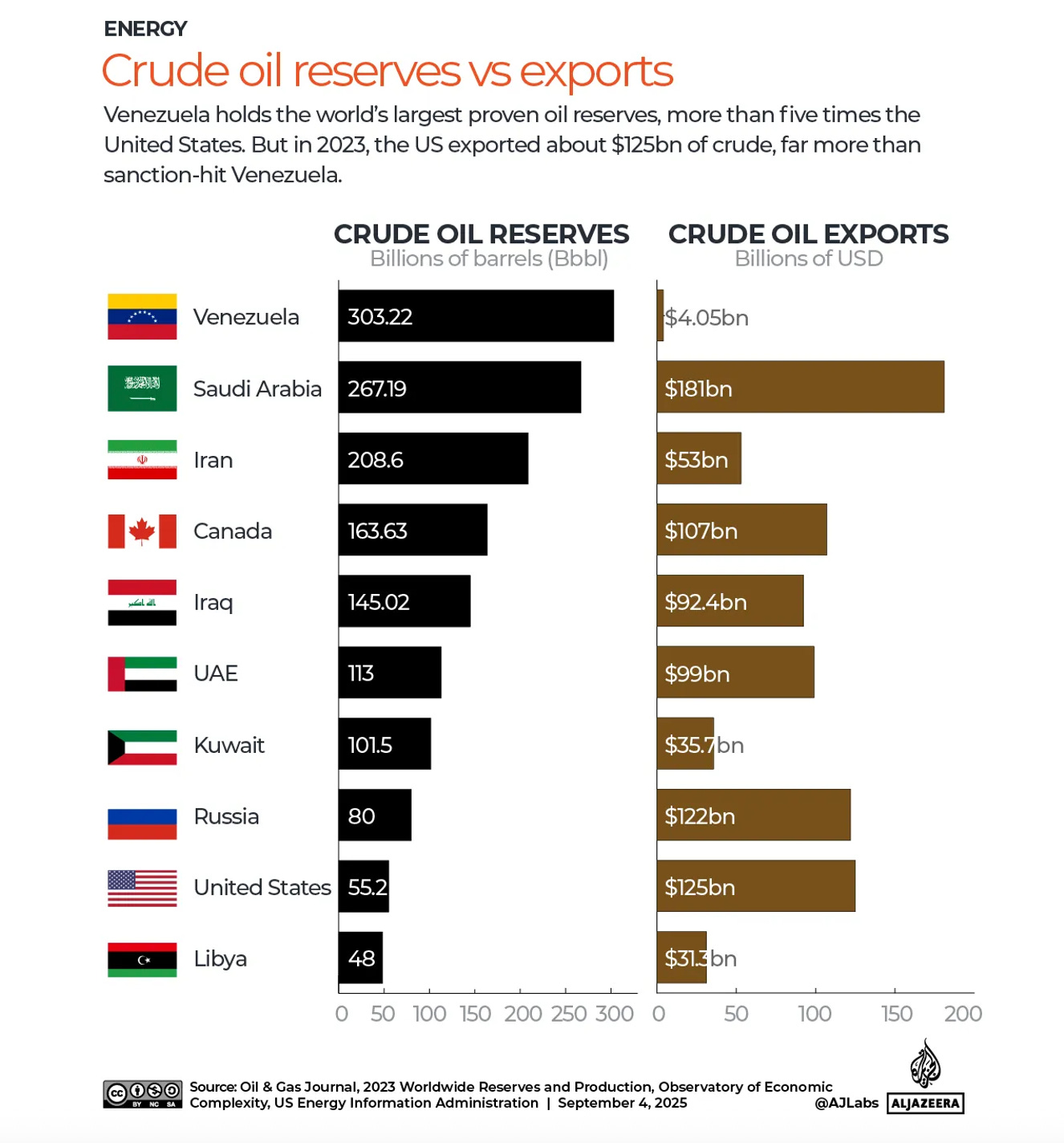
The stakes are even higher today than in the mid-twentieth century, because oil prices are higher. If Trump were able to restore the lopsided financial terms of that earlier era, the windfall captured by U.S. oil companies and their owners would be correspondingly larger.
When Trump says he wants to “run” Venezuela, this is what he is talking about.
To fix ideas, Saudi Aramco—the oil producer of Saudi Arabia, which holds the world’s second-largest reserves—has reported annual profits of roughly $100 to $150 billion in recent years.
This is, give or take, the order of magnitude at stake today behind Maduro’s removal: $100–150 billion per year to be captured by US shareholders of oil companies, should a new regime friendly to US interests take power in Caracas.
I'm french but english is the new latin( for we(sterners))
Venezuelans were doing alright under Chávez : https://cepr.net/publications/venezuelan-economic-and-social-performance-under-hugo-chavez-in-graphs (Venezuelan Economic and Social Performance Under Hugo Chávez, in 12 Graphs), here is a longer version https://cepr.net/documents/publications/venezuela-2009-02.pdf , whose executive summary mentions that « Most of this growth has been in the non-oil sector of the economy »
The sanctions began after the 2016-2017 oil crisis, see fig.1 and 2 https://cepr.net/images/stories/reports/venezuela-sanctions-2019-04.pdf
The same report states that « According to the National Survey on Living Conditions (ENCOVI by its acronym in Spanish), an annual survey of living conditions administered by three Venezuelan universities, there was a 31% increase in general mortality from 2017 to 2018. This would imply an increase of more than 40,000 deaths. », it was published in April 2019, so no doubt that many more died.
The fig.1 in https://sanctionsandsecurity.org/wp-content/uploads/2022/01/January-2022-Venezuela-Case_Rodriguez.pdf shows a better view of the impact of sanctions on Venezuela's oil production.
It is stated here(, https://www.ohchr.org/en/statements-and-speeches/2021/02/preliminary-findings-visit-bolivarian-republic-venezuela-special ,) that « The Government’s revenue was reported to shrink by 99% with the country currently living on 1% of its pre-sanctions income. », isn't that unbelievable ? Their foreign currency revenue also dropped.
However they survived so much, and in 2024 Venezuela (finally!) had the highest g.d.p. growth of South America https://www.cepal.org/sites/default/files/pr/files/tabla_nuevas_proyeccionespib_oct-2025.pdf
They also went back to a million barrels a day, very quickly rising https://tradingeconomics.com/venezuela/crude-oil-production
The US attacked because sanctions stopped having an effect. Extinguishing socialism is the objective, oil is to strengthen themselves, that's why they're also sanctioning Cuba or attacked the USSR. They also attacked Iraq/Iran/Syria/Lybia/.. primarily to weaken anti-Israel countries, more than to strengthen themselves through oil https://youtu.be/dSVGy8fhMYs .
No need to prove that it's not about drugs, but it's not only about oil(&gold), since it's also against socialism. And these accusations of dictatorship can only be thrown by those ignoring the venezuelan communes.
Venezuela was transforming itself into a federation of free communes, until now they still have the possibility to decide of the budget of their communes, and many do participate, the women appear to be the most active. Accusations of fraud are hard to dismiss, they're systematically used against our enemies despite many international observers, as well as https://x.com/i/status/1817560455646236974 , and you've shown what kind of venezuelan leader they want in place, thanks for reading.
Hm. I’d like to have some deeper analysis of what this idea of it ‘all being about oil’ actually means, if the economics of oil extraction and refininement aren’t good.
Zucman is claiming that pure oil $$ considerations driving recent events in Venezuela, against what appears (to me) to be more comprehensive and subtle consideration by folks like Ganz, who aren’t denying that ‘oil brain’ is playing a part (because Trump is stuck in the past), but also trying to understand the ideological and psychological and political motivations. And to question whether the oil $$$ framing even makes sense. Especially given the recent reporting that Oil companies are basically saying “??????” to the prospect of trying to fix Venezuelan infrastructure.
https://open.substack.com/pub/johnganz/p/crude-ideology